Saturday, November 8, 2014

Peroxidase Enzyme Lab Cold V.S Hot

Peroxidase Enzyme Lab by Mason Mowery

Introduction:
Enzymes are proteins made up of amino acids that are catalysts in reactions inside and outside of almost every living organism, and are activated by substates like hydrogen peroxide. They help our body in many ways including our immune system and digestive system. In the immune system enzymes alter toxins into harmless substances, and enzymes in the digestive system brake down giving us a good source of protein. Our experiment is taking place to find the optimum temperature for enzymes to react.

Hypothesis: If the temperature of an enzyme is increased then the more effective it will be at decomposing hydrogen peroxide.


Materials


  • 5 to 10 grams of freshly picked bindweed vines with leaves (about 1 handful)
  • Mortar and pestle
  • Distilled water
  • 3 100-liter glass or plastic beakers
  • 1 mL or 5 mL syringe
  • Hydrogen peroxide
  • 1 Paper towel square (for filtration)
  • Glass test tubes
  • Test tube rack or holder
  • Small plastic ruler
  • Safety glasses
  • Ice
  • Large plastic beaker (for ice bath)
  • Hot water
  • Large plastic beaker (for hot water bath)
  • Thermometers


    Procedure


    1st: Gather Materials
    2nd: Refer to lab set up
    3rd: Crush bindweed
    4th: Measure 20 ml of hydrogen peroxide
    5th;Tape test tube to ruler ( cm side ) sd
    6th:put 1.cc (1.5cm) bindweed in the test tube
    7th: put 1.cc (1.5cm) peroxide in a seprete test tube
    8th: put test tubes in varying celsius for 2 min
    9th:time the reaction time to 2 min
    10th:record data in a bar graph
    11th:write a conclusion


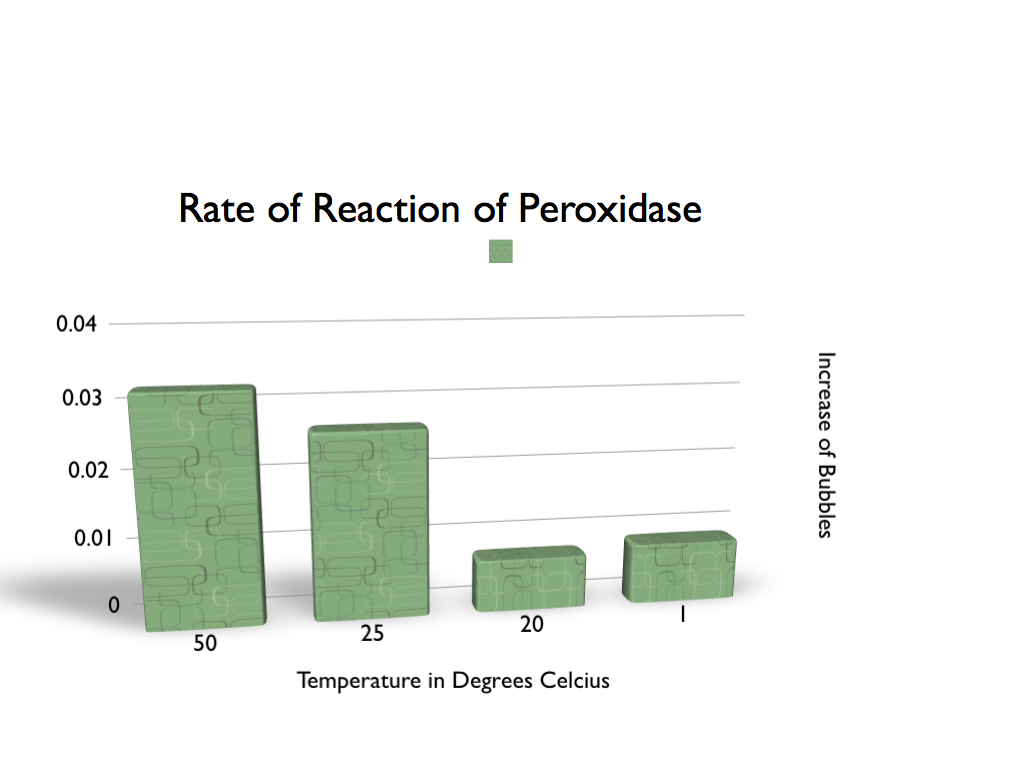
    (test tube)(degrees Celsius)(hight in centimeters)(hight reaction)(avrage)
    1st
    50 deg C
    1.6 cent
    49.48 sec
    av .0323


    2nd
    25 deg C
    4.4 cent
    2:45.80 sec
    av .0265


    3rd
    20 deg C
    .5 cent
    67 sec
    av .00756


    4th
    1 deg C
    .7 cent
    80 sec
    av  .00875


    peroxidase_graph.001.png


    Conclusions:


    Our enzyme lab began with a rocky start. We could not find the bindweed, we had very little thought in which direction to take the lab, and we had to remake and re-collect any supplies that we had originally collected. Once able to collect the supplies I was capable of preparing the solutions of bindweed and hydrogen peroxide. Each solution was 1cc or 1.5cm tall in the test tubes. After finalizing the set up of solutions I observed the thickness of the bindweed set up and inferred that the extra substance is from the exposed enzymes. I did note that when we poured the hydrogen peroxide into the test tubes the glass formed for a second due to lack of previous cleaning. This could have had an effect on the reaction that occurred in the test tube because a portion of the peroxide had already reacted to something else. Our final preparation consisted of gathering a timer  and the temperature controlled boxes. The separate boxes temperatures consisted of 50 25 20, and 1 degree(s) celsius.

    The first test ran two times due to a spillage and a lack of communication, but the second time ran a lot smoother.  The water in the first chamber was 50 degrees celsius, which was a notable difference to the cold morning air that filled the room. I noticed that the moment the two test tubes hit the water, the glass foged up. After waiting two minutes for the substances to reach 50’ celcius we pulled the test tubes out, and pourd the peroxide into the enzyme. After the peroxide settled, bubbles reached up to 1.6 cm higher than the liquid mixture, and stayed in that spot for a few seconds before receading. The next test tube was in a controlled enviornment of 25 degrees celcius for two minutes. These test tubes also fogged up but at a slower rate. This gave me the impression that the reaction time of the enzymes would be slower, but I was wrong. It actually took  2:45.80 seconds to reach its maximum bubble hight of 4.4cm more than the solutions hight. Amazeingly enough no discoloration was found in the solution after or during the reaction.

    The last two tests were run at 20C and 1C. The 20C test was the room temperature at the 
    time and it only gave me the increase of .5cent which is odd due to the fact that its not that far of from 25C. The final test as expected was low .7 increase, but oddly it had a higher increase than room temperature. From my experiment I have learned that my hypothesis was correct because the higher temperature got the most increase. Altho it was a good lab we should have spent more time as a whole to figure out problems and even solve the mystery of the room temperature test. I also should have cleaned the equipment before use, but in a whole we did good.


Friday, November 7, 2014

Enzyme pH lab

pH and it’s effect on enzymes
Introduction:
Our experiment tested how enzymes are affected by different pH levels. Enzymes are proteins made up of amino acids which act as catalysts in an organic reaction. These catalysts turn toxins into harmless substances, help you digest, and boost your immune system. Enzymes are triggered by substrates such as hydrogen peroxide or lactase. Not only do enzymes help in digestion, but they speed up any reaction in the human body. Enzymes can be found in almost any living thing on earth.
Purpose:
To test how the rate of a chemical reaction between an enzyme and substrate varies with different pH levels.
Hypothesis:
My hypothesis stated that the enzymes rate of reaction increases as a mixture becomes more basic. If pH levels are related to the enzyme’s rate of reaction, the more basic the solution is, the bigger the column of foam triggered by the reaction will be.
Materials:
Hydrochloric acid
sodium hydroxide
hydrogen peroxide
water
syringes
beakers
safety goggles
test tubes
bindweed
Mortar and pestle
Iphone
Procedure:


1.) Go to the garden and pick a handful of bindweed
2.) Grind up the bindweed leaves in a mortar and pestle
3.) Add 20 ml of H2O to the mortar containing the bindweed and blend with the pestle
4.) Extract the enzyme by pouring the bindweed mixture through a paper towel into a beaker
5.) Put 1 ml of the extract into each test tubes with 1 ml of the varying pH Mixtures
6.)  Add ½ ml of hydrogen peroxide to one test tube at a time
7.) Measure the reaction in mm with a ruler
8.) Repeat steps 6 and 7 until all test tubes have been used
9.) Record and analyze results
Observations and data:


7 pH

10 pH

7.5 pH

6.5 pH

5.5 pH


control 1
control 2
pH 12//1
pH 12//2
pH 10//1
pH 10//2
pH 3-4//1
pH 3-4//2
pH 2-3//1
pH 2-3//2

3.87
3.14
1.46
2.98
0.46
1.68
1.16
3.51
1.54
1.66

6.29
13.07
3.17
4.32
1.37
3.19
4.21
8.37
5.43
4.96

8.2
17.35
5.28
5.93
2.53
4.67
7.54
27.58
12.04
10.81

10.15
20.98
6.67
8.17
4.41
6.55
10.85


17.37

12.56
24.68
8.23
12.68
5.14
8.14
13.78


15.94
29.94
9.68
15.49
6.37
9.77
17.04


20.3

11.26
17.94
7.7
11.72
24.59


23.18

12.91
20.78
9.41
13.6


26.14

14.74
24.16
10.91
15.94


29.45

17.34

12.9
18.34


32.88


14.28


36.63


17.3


40.94


Data analysis:
The graph is read as every point being one mm.  Each of these lines is the average of our two experiments for every different pH.image-3.png


Conclusion:
Our data shows that the control and higher basic pHs affected the enzyme’s reaction the most. With the pH of 10 and 12, the foam reaction was much larger and sustained for a longer amount of time than either of the acidic solutions. Because of this data, my hypothesis tested correct. An abiotic factor such as pH levels influence the rate of a reaction in an enzyme most with basic solutions, such as sodium hydroxide. More basic bodies would result in faster reactions with enzymes, causing your body to be overall healthy. With a more acidic body, reactions will take longer time and you may be less healthy.

Thursday, November 6, 2014

Blog Post #6

All of the plants have been growing at a gradual and healthy rate. This is because of the recent changes in the weather that have allowed the plants to continue its photosynthesis. Photosynthesis has let the plants cells divide and in return create more mass in our plants stems and leaves. All plants make enzymes which have a large purpose in the growth of our plant.
In a eukaryotic cell, the enzymes are made in the endoplasmic reticulum. In the ER, an enzyme is created through instructions from RNA. During this process the enzyme can go under a series of changes. Some changes might include mutation and the normal process. If an enzyme goes through mutation it will either be defective or it will be able to do a new tasks that other enzymes previously do.

blog post 6 Fassil 🌻🌻

Our plant is still growing. But how is it growing. The plant is increasing its biomass through mitosis is a type of cell division that results in two daughter cells. Mitosis in a plant is when a eukayotic cell separates the chromosome in its nucleus into two daughter nuclei. Then the cytokinesis comes in and divides the cytoplasm,  organelles, nuclei, and the cell membrane into two daughter cells.

Photosynthesis is a pathway that converts the light energy into chemical energy. The plant already has carbon dioxide and water it uses the energy to cause a reaction and get products like oxygen and carbohydrates.


Masons How Does Your Garden Grow (#6)

All of the plants have been growing very well lately. This is partially due to the slight breaking the cloudy weather which allowed the plants to speed up its its photosynthesis. Extra energy from photosynthesis let the plants cells divide through mitosis and in turn creates more mass in our plants.All plants make enzymes and all of them make enzymes for a purpose. 
In a eukaryotic cell enzymes are made in the endoplasmic reticulum. While in the ER the enzyme is created by the instructions from RNA, and can go under a series of changes. Some changes might include mutation defection and the normal process. If an enzyme goes through mutation it will either be defective or it can do a new better task that other enzymes coldest previously do.    


blogpost #6

My plant is increasing in biomass because of mitosis. Mitosis reproduces cells and this expands the area of the plant. Through photosynthesis, the plant receives energy from the sun and uses that to grow by creating photosynthetic biomass. It stores this energy in chemical bonds, which in turn gives the plant glucose. Respiration is the process of taking in oxygen and producing carbon dioxide by burning sugars. These burnt sugars make the plant grow and is usable energy for other internal processes of the plant.
If my cabbage needed enzymes, it would first copy it’s DNA for the needed protein. then the mRNA would change the code into amino acids so a protein could be manufactured. when enough strands have been synthesized, the enzymes will be complete.

Tuesday, October 21, 2014

blog post #5 fassil 🌱

This week our plant looks a little bigger. Our plant is alive because it can eat, breath, drink, and it produces a waste product carbon dioxide. It gets its energy from the sunlight through a process called photosynthesis. The plant drinks water by absorbing it through its roots. But most importantly its made up of cells.

Since our plant was just a seedling I knew it was going to do great things to help the worlds pollution problem. The plant has grown a lot since it was just a seed 3 months ago, it grew about 6 inches. The plant also changed color it used to have a brown stem and light green leafs, but now it has a purple stem and dark green leafy.


Monday, October 20, 2014

Blog Post #5

Our cabbage plant is living, and you can tell it is so in many different ways. To begin with, all living things adapt to the environment, grow and eventually mature. Our plant is doing all of the following and is continuing to do so day by day. Our plant came from a seed that was produced from another plant of the same brassica oleracea family. Also, our plant has adapted to several different changes in the environment. These changes include a massive change in weather and insects feeding on the plant for food. All of these observations illustrate how our plant is living and thriving.